
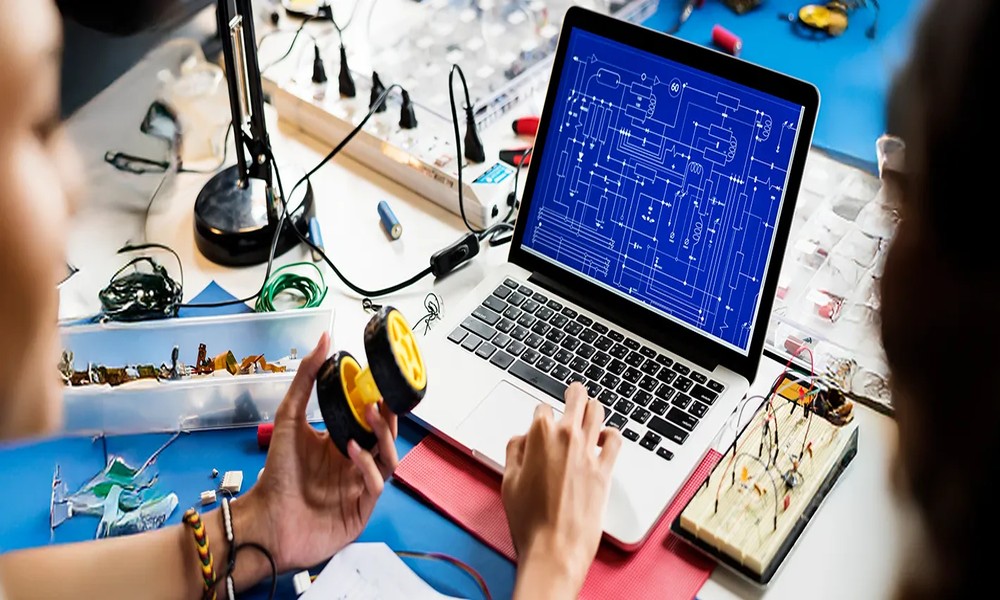

Engineering education provides a versatile set of skills that go beyond technical work and will remain useful throughout an engineer’s career in any industry. The purpose of this article is to explore some of the major competencies which engineering students will gain while pursuing their studies. Knowledge of these skills makes the potential students recognize the worth of an engineering degree.
The competencies developed by engineering students
Analytical and critical thinking abilities
Engineering education improves a student’s ability to divide complex problems in terms of their component parts so as to resolve each part separately. Students develop an approach to analyze situations based on more than one view point prior to developing the most effective solution. The following are the analytical skills that have been acquired in engineering studies:
- Systematic problem decomposition: Breaking down large and complicated problems into smaller and solvable components in order to solve them effectively.
- Root cause analysis: Identifies root factors underlying problems and does not treat only the superficial effects of the problems.
- Critical evaluation: Evaluating proposed solutions against requirements, constraints and possible failure modes.
- Data interpretation: Assessing numerical information and results of experiments in order to derive meaningful conclusions.
- Trade-off analysis: Students balance competing requirements to provide the best possible solution within established constraints.
Project management capabilities
study engineering projects involve mobilizing resources, time and personnel to certain objectives. The learners are taught to plan, implement and present outputs under limitation. The students will develop the following project management skills throughout this course
- Timeline planning: Subdivision of projects into schedules and milestones that are realistic.
- Resource allocation: Some tasks are assigned the limited personnel, equipment and budget.
- Documentation practices: clear decisions, calculations, and design changes.
- Quality control: Verifying that output meets specified requirements before completion.
Design and creativity application
Engineering design demands the development of new solutions under realistic restrictions. Students are taught systematic methods of innovation which regulate creativity as well as viability. The following are the developed design skills:
- Requirements translation: Translating the needs into actual and specific design requirements.
- Concept generation: Generating various solutions in order to get optimal methods.
- Prototyping techniques: Finding workable variations of designs to be tested and improved.
- Iterative improvement: Software design involves successive design improvements with the help of testing feedback.
- Standards compliance: Incorporating industry practices, relevant codes and regulations.
Discussing the frequently asked questions
What is the best thing that was learnt in engineering?
The transferability and value of the engineering education skill that is most often regarded as such is problem-solving ability.
Is there an application of engineering skills beyond technical applications?
Analytical thinking and project management skills are indeed more than welcome in business and finance, and consulting.
What are the ways in which students of engineering learn to be team workers?
Teamwork and laboratory activities demand that students organize and distribute their tasks and work together.
Do communication skills actually exist in engineering courses?
Yes, the majority of the programs entail writing and presentation of technical nature over the course of the curriculum.
What is the most desirable skill that employers require among engineering graduates?
Problem solving ability and practical application of knowledge are ranked by employers to always come at the top.



Leave a Comment