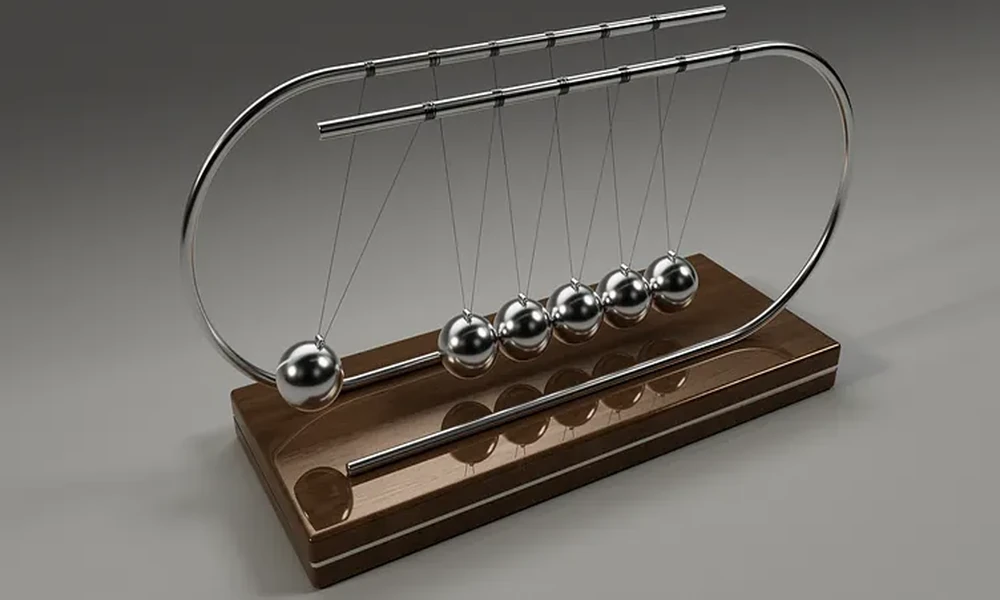

Designed to make middle school physics engaging, the Newton’s Cradle simulator turns textbook rules into clear visual experiments. Students can test symmetrical collisions from single-ball swings to multi-ball drops to see how momentum and kinetic energy stay balanced across every impact. Using the clean toggle settings, learners can focus on momentum alone, kinetic energy alone, or compare both side by side as the spheres swing back and forth. This Active Kinetic 1 Newton’s cradle is a practical teaching instrument for introducing elastic collisions, impact forces and collision dynamics. It mimics a row of suspended steel balls and provides a visually appealing example of what happens when moving objects interact over a very short interval. Students may initially assume that the first ball simply pushes all the others forward, but the resulting motion invites a more careful investigation of force transmission and energy transfer.
In an ideal elastic collision, the combined momentum and total kinetic energy of the participating bodies are conserved. A traditional Newton’s cradle approximates these conditions because its metal spheres are hard, similar in mass and carefully aligned. When one ball strikes the row, the metal compresses by a tiny amount and contact forces rapidly spread through neighbouring spheres. The last ball then swings outward while the others move relatively little. Real devices can show small secondary movements, imperfect timing and reduced rebound speeds.
These details allow educators to explain the coefficient of restitution, a measure related to the relative speeds before and after an impact. Students can compare an idealised collision with one in which energy is dissipated as heat, sound or material vibration. They can also investigate why the apparatus needs consistent ball sizes, accurate suspension geometry and reasonably rigid supports to produce its familiar pattern.
This Newton’s Cradle tool helps to compare the movement of one incoming ball with two or three incoming balls. Learners can practise constructing hypotheses, identifying variables and interpreting experimental evidence. It also provides a chance to discuss how simplified assumptions help scientists build models without claiming that laboratory equipment behaves perfectly. For physics and engineering education, the Newton’s cradle offers a compact model of collision mechanics that bridges textbook conservation laws and the more complicated behaviour of real materials during impact.
To bridge the gap between classroom theory and everyday reality, the tool features both frictionless harmonic motion and realistic mechanical decay. Students can watch the energy retention counter drop as each collision loses tiny amounts of power to heat, sound, and air drag. In addition, the built-in Paradox mode offers an instant visual answer to a classic science riddle, clearly showing how energy goes missing if one ball tries to push two balls out at half speed.
Newton’s Cradle Simulator
Compare classical mechanical sphere impacts with parallel-face Active Magnetic Cradle (AMC) dipole carriages.